


How high can an electric forklift lift
 Oct 22, 2025|
 View:507
The vertical reach of an electric forklift is a critical factor in material handling operations, influencing everything from warehouse layout design to operational efficiency. While these machines are often perceived as limited to ground-level tasks, modern electric forklifts demonstrate remarkable lifting capabilities that challenge traditional assumptions. This article explores the technical boundaries, operational considerations, and industry trends shaping the vertical performance of electric forklifts.
Technical Limits: From Compact Models to Heavy-Duty Systems
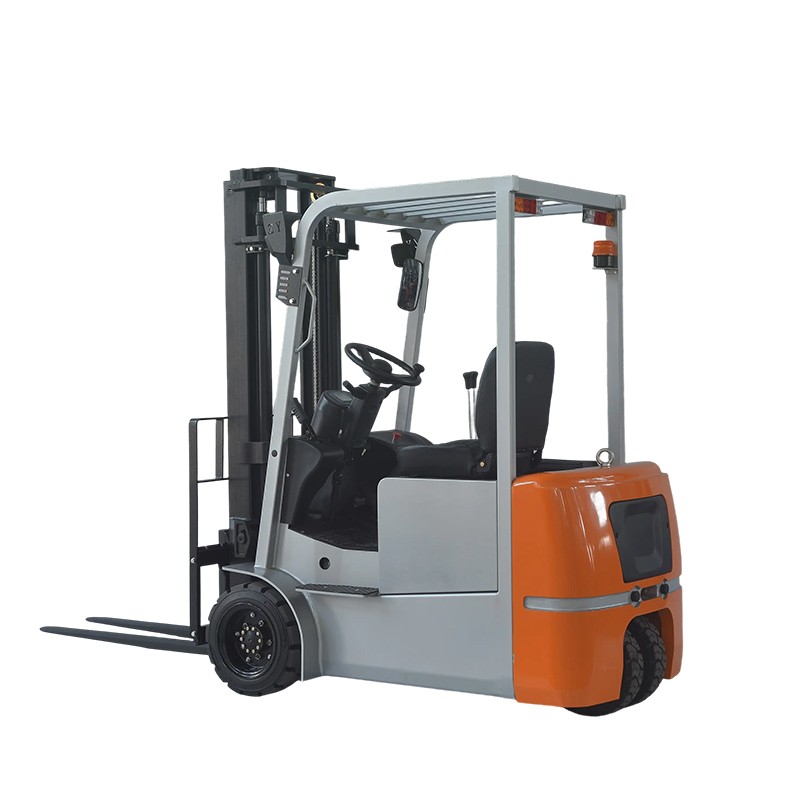
Electric forklifts exhibit a wide range of lifting heights depending on their design classification. Compact warehouse models, optimized for narrow aisles and indoor operations, typically achieve maximum lift heights between 5.5 meters (18 feet) and 7 meters (23 feet). For instance, a standard electric forklift with a 4,400-pound capacity can elevate loads to 118 inches (3 meters), while specialized high-reach variants extend this to 23 feet for pallet storage in multi-tier racking systems.
Heavy-duty electric forklifts, engineered for industrial applications, push these boundaries further. Models in the 9-18 ton (20,000-40,000 pounds) category demonstrate lifting heights up to 6.5 meters (21.3 feet) with advanced mast designs. A notable example is a 2.5-ton electric forklift featuring a 10.5-meter (34.4 feet) lifting capacity, achieved through multi-stage masts and reinforced structural components. These systems incorporate overhead tilt cylinders and torsion-resistant masts to maintain stability at extreme heights.
The record for electric forklift vertical reach is held by specialized multi-directional models, such as a 2.5-ton unit capable of elevating loads to 10.5 meters. This performance is enabled by all-wheel steering systems and real-time driving wheel position monitoring, which compensate for the reduced stability inherent in high-altitude operations.
Operational Factors Affecting Lifting Performance
While manufacturers specify maximum lifting heights, real-world performance depends on several interrelated factors. The most significant is the load center distance—the horizontal space between the cargo's center of gravity and the fork's vertical plane. Standard electric forklifts assume a 500mm (20-inch) load center, but deviations reduce effective capacity. For example, a forklift rated for 3,300 pounds at a 500mm load center might only handle 2,200 pounds if the load extends to 600mm.
Mast design also plays a crucial role. Three-stage masts, common in high-reach models, provide greater vertical extension but introduce complexities in load stability. Advanced systems incorporate synchronous reluctance motors and energy management software to optimize power distribution during elevation. A Toyota-designed AC motor, for instance, improves energy efficiency by 15% while maintaining consistent torque across lifting phases.
Battery technology further influences performance. Lithium-ion power systems, standard in modern electric forklifts, deliver sustained voltage under load compared to traditional lead-acid batteries. This enables smoother acceleration and precise control during high-altitude maneuvers. Some models integrate battery management systems that adjust power output based on real-time mast position data.
Industry Applications and Trends
The demand for high-reach electric forklifts is driven by evolving warehouse architectures. Automated storage and retrieval systems (AS/RS) require machines capable of operating in aisles as narrow as 3 meters (10 feet) while accessing racks up to 12 meters (40 feet) tall. Electric forklifts excel in these environments due to their zero-emission operation and quiet performance, which are essential in temperature-controlled facilities.
In the beverage industry, electric forklifts with 23-foot lifting capacities are used to stack pallets in multi-level distribution centers. Similarly, automotive manufacturers deploy 10,000-pound capacity electric models to lift engine blocks and chassis components in assembly plants. The shift toward electrification is also evident in port operations, where 18-ton electric forklifts handle containers with lifting heights exceeding 6 meters.
Technological advancements continue to redefine possibilities. Multi-directional forklifts, equipped with 360-degree steering, enable lateral movement in confined spaces while maintaining vertical reach. These systems are particularly valuable in cross-docking operations, where rapid repositioning of high-stacked goods is required.
Conclusion
The lifting capabilities of electric forklifts have evolved far beyond their traditional role as ground-level material handlers. Modern electric forklifts demonstrate vertical reach exceeding 10 meters in specialized applications, while standard models reliably serve 7-meter high racking systems. These advancements are driven by innovations in mast design, motor efficiency, and battery technology, which collectively enable electric forklifts to match—and in some cases surpass—the performance of internal combustion counterparts.
As industries prioritize sustainability and operational precision, the electric forklift's role in vertical material handling will continue to expand. The combination of zero-emission operation, quiet performance, and advanced safety systems positions electric forklifts as indispensable tools for modern warehouses and industrial facilities. Whether lifting 3,300 pounds to 189 inches or moving 12,000-pound loads in high-bay storage, the electric forklift proves that vertical limitations are being redefined through engineering ingenuity and technological progress.


