


What is a reach truck
 Oct 10, 2025|
 View:532
In the dynamic world of warehouse logistics, efficiency and precision are paramount. Among the array of material handling equipment, the reach truck stands out as a specialized solution designed to optimize space utilization and operational productivity. This article delves into the definition, design, applications, and advantages of reach trucks, highlighting their indispensable role in modern warehousing.
Definition and Core Design
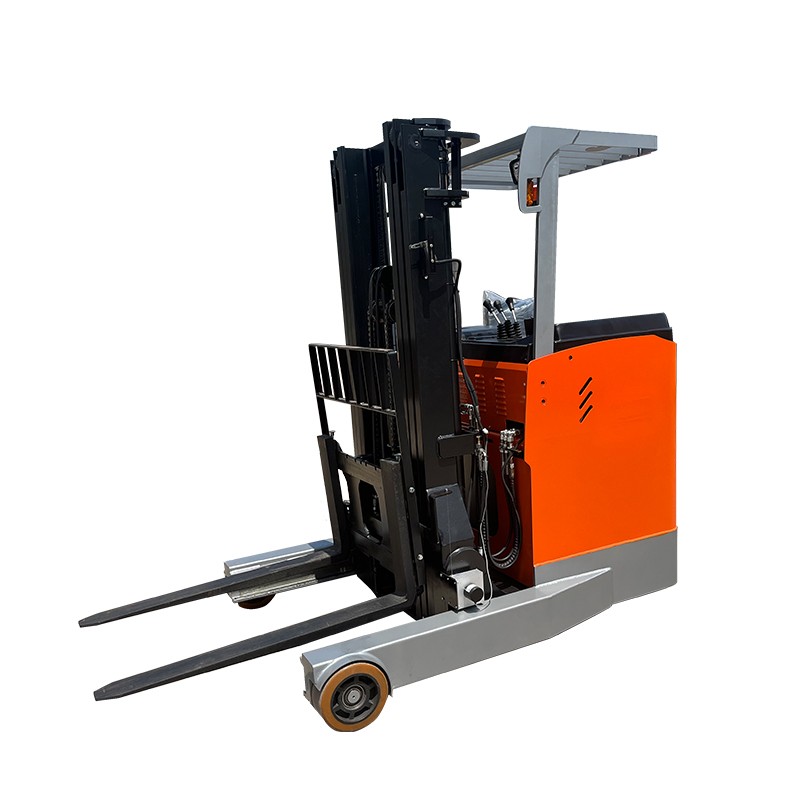
A reach truck is a narrow-aisle forklift engineered for indoor operations in environments where conventional forklifts struggle to maneuver. Unlike traditional counterbalance forklifts, which require wide aisles to turn, reach trucks feature a compact chassis and a unique mast system. Their defining characteristic is the extendable mast and fork carriage, which allows the forks to reach forward beyond the truck’s wheels. This mechanism enables operators to pick and place loads in high racks while navigating tight aisles, often as narrow as 2.4 meters.
The truck’s design prioritizes stability and visibility. Most models have a three-wheel configuration—two front wheels for steering and a single rear wheel for support—or a four-wheel setup with rear-wheel steering. The operator cabin is elevated, providing a clear view of the racks and surroundings. Additionally, modern reach trucks incorporate ergonomic controls, adjustable seating, and digital displays to enhance operator comfort and safety.
Key Features and Innovations
1.Maneuverability: The narrow chassis and tight turning radius allow reach trucks to operate in confined spaces, making them ideal for high-density storage layouts.
2.Vertical Reach: Depending on the model, reach trucks can lift loads to heights exceeding 12 meters, accommodating multi-tiered racking systems.
3.Load Capacity: While primarily designed for palletized goods, reach trucks typically handle loads ranging from 1,400 kg to 2,500 kg, with some models supporting heavier weights.
4.Stability Systems: Advanced models include features like automatic speed reduction on turns, tilt angle limits, and regenerative braking to prevent tip-overs.
5.Technology Integration: Many reach trucks now offer connectivity with warehouse management systems (WMS), enabling real-time tracking of inventory and operational data.
Applications in Warehousing
Reach trucks excel in environments demanding vertical storage and rapid material flow. Common use cases include:
High-Rack Warehouses: Retrieving and storing pallets in tall racks, maximizing floor space by reducing aisle width.
Distribution Centers: Handling fast-moving consumer goods (FMCG) in narrow aisles, where speed and accuracy are critical.
Cold Storage Facilities: Operating in refrigerated environments, where compact design minimizes heat loss and energy consumption.
Retail Backrooms: Stocking shelves in supermarkets or e-commerce fulfillment centers with limited space.
Their ability to access deep racks without repositioning the entire truck reduces cycle times and labor costs. For example, a reach truck can retrieve a pallet from the third tier of a rack in a single motion, whereas a conventional forklift might require multiple adjustments.
Advantages Over Traditional Forklifts
1.Space Efficiency: By enabling narrower aisles, reach trucks increase storage capacity by up to 30% compared to traditional layouts.
2.Safety: Elevated cabs and improved visibility reduce the risk of collisions with racks or personnel.
3.Productivity: Faster retrieval times and reduced downtime contribute to higher throughput.
4.Versatility: Some models, like the "Indoor/Outdoor Moving Mast Reach Truck," adapt to both indoor and outdoor environments, though most are optimized for indoor use.
Conclusion
The reach truck is a cornerstone of modern warehousing, blending precision, efficiency, and safety to meet the demands of high-density storage. Its ability to navigate tight spaces, lift loads to significant heights, and integrate with digital systems makes it an invaluable asset for businesses seeking to optimize operations. Whether in distribution centers, cold stores, or retail backrooms, the reach truck’s versatility ensures it remains a critical tool for enhancing productivity and reducing costs. As warehouses continue to evolve toward automation and space maximization, the reach truck will undoubtedly remain at the forefront of material handling innovation.
FAQ
Q: What is the maximum lifting height of a standard reach truck?
A: Most standard reach trucks offer a maximum lifting height between 9 to 12 meters, depending on the model and load capacity.
Q: How does a reach truck differ from a counterbalance forklift?
A: A reach truck uses outriggers and a pantograph mechanism for narrow aisle operation, while counterbalance forklifts rely on weight distribution for stability.
Q: What safety features are essential for reach truck operation?
A: Key safety features include overload protection, emergency stop buttons, and visibility enhancements like cameras or LED lights for narrow aisles.
Q: Can reach trucks operate in cold storage environments?
A: Yes, specialized reach trucks with enclosed cabs, heated seats, and corrosion-resistant components are designed for cold storage applications.
Q: What maintenance is required for optimal reach truck performance?
A: Regular checks on hydraulic systems, battery health, and wheel conditions, along with daily inspections, ensure longevity and safe operation.


